
Brought to you by Sourcebooks Landmark
For centuries, the Hua women held sway over the courts of emperors and the boardrooms of billionaires…and in every fifth generation, an eldest daughter is born with the rarest gift of all: the ability to summon true love. As a long-awaited fifth daughter, Lucy was supposed to be the miracle her exacting mother had been waiting for. But her magic failed and she fled. When a death in the family brings her home, she must confront the tangled threads of love, power, and identity...and ask herself whether her magic was ever truly gone, or waiting for her to decide what it means to be a daughter of the House of Hua.
None of us is truly a solitary individual. All of us have been shaped by the people who came before us—by the traumas and triumphs our ancestors endured, by the genetic matter that helices in our cells, by the choices a former generation made on the laws, morals, and landscape of our society. A long, long time ago, a Jewish family left Spain and ended up in Greece, and here I am. From four grandparents, I inherited wavy brown hair, but unfortunately, I missed the genes for good, strong teeth. I grew up in a New Jersey and a United States shaped by the choices, votes, and morals of other generations.
Perhaps all this is why intergenerational novels are so engrossing and why so many readers are drawn to them. We’re all made up of the past and future, and these novels lay that bare, making all the little connections that we know are there, even if so many of us don’t, or can’t, know all the details of where we come from. In these 10 fantastic works, we follow families through the decades, seeing what choices become turning points, and how the vagaries of history can change the course of humanity.
Perfect for long commutes or for the beach, these 10 great intergenerational stories are ready for you to dive into and enjoy.
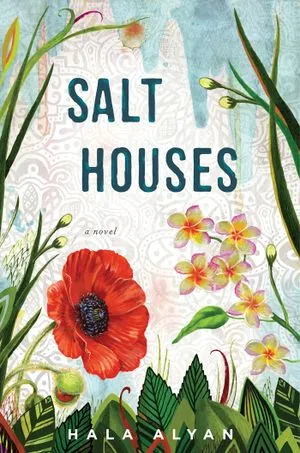
Salt Houses by Hala Alyan
Just before her daughter’s wedding, mother Salma reads her daughter Alia’s coffee dregs and decides to lie about what she sees. From there, this multigenerational tale of displacement and heartbreak unspools. The family is forced out of Palestine and proceeds to live in a multitude of places, from Kuwait City to Boston. As we follow the generations, we watch how the impact of disconnection, nostalgia, and conflict is channeled through the minds and hearts of family members.

Disoriental by Négar Djavadi, translated by Tina A. Kover
Kimiâ, a queer, punk rock–loving woman, sits in a maternity waiting room in Paris and thinks back on her and her family’s past. She recalls how her parents, who were intellectuals, opposed the regime of first the Shah and then Khomeini; they were eventually forced to flee Iran, children in tow. It’s an autobiographical novel by Djavadi, which enriches the story with a convincing sense of honesty, and its weaving of interlocking tales is masterfully executed.

Homegoing by Yaa Gyasi
This stunning debut begins with two half-sisters, Effia and Esi, born in Ghana. It follows their family lines through generations, as one line is haunted by water and the other by fire; one line is sold into slavery, and the other remains in Africa. Gyasi’s gorgeous, deliberate prose dips and dives across centuries of history, telling stories that are both fascinating in their own right and meaningful as part of the large, complex embroidery of this family’s legacy.

Moonbath by Yanick Lahens, translated by Emily Gogolak
A girl is found washed up on the shore of Haiti. But to tell her story, we have to dive back in time, starting with her grandmother Olmène, who caught the eye of the son of a family who had feuded with her own for generations. Over the course of several decades, Cétoute’s story unfolds, and so does the tale of this Haitian family, fighting, fleeing, returning, and suffering love and heartbreak. Bonus: for a multigenerational tale, it’s short, at just around 200 pages.

The Vanishing Half by Brit Bennett
The two Vignes sisters, both Black and from the south, go very separate ways after running away from home. Desiree has a child and returns to the town she once left with her. Stella, however, learns that she can pass as white and does so, living in Los Angeles with her husband and daughter, neither of whom has any idea of her past. The novel moves backward into Black American history in the 1950s and focuses on its protagonists, even as it shows how the past shapes their actions.
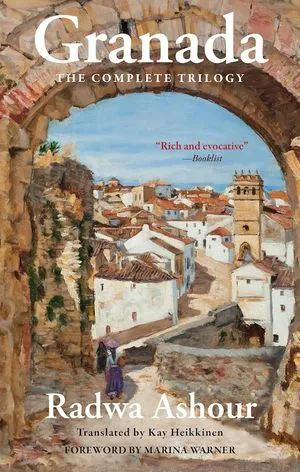
Granada by Radwa Ashour, translated by Kay Heikkinen
Egyptian author Ashour tells the story of a Muslim family living through the aftermath of the 1492 fall of the prosperous Muslim kingdom of al-Andalus to the Castilian Spanish. In the winding neighborhood of the Albaycín, generations of a family–beginning with Jaafar; his daughter, the intelligent, sharp Salima; and his two apprentices, Naeem and Saad–and their struggle to survive as the Spanish fight to erode and stamp out Muslim beliefs and culture from Granada.
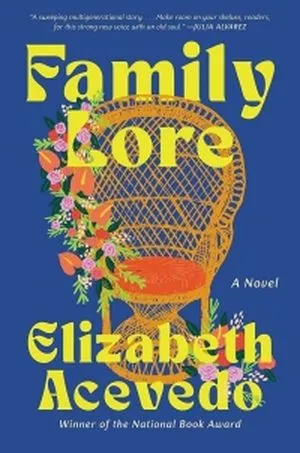
Family Lore by Elizabeth Acevedo
Flor has always known when people are nearing their time of death. So when she sees her own end is coming, she decides—to the dismay of her family—to hold her own wake while she’s still alive. As the novel goes on, we learn the backstories and present hopes of all six Marte women, including Flor’s sisters Matilde, Pastora, and Camila, and the younger generation, Ona and Yadi. The story of one Dominican-American family quickly shifts into shape in this novel that connects Santo Domingo to the Big Apple.
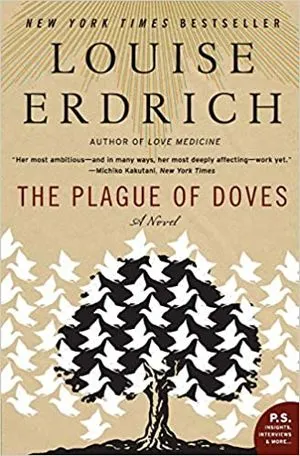
The Plague of Doves by Louise Erdrich
When a farm family is murdered, a group of local Ojibwe men is lynched for the crime. But everyone knows now that they were innocent. We primarily follow protagonist Evelina Harp and her grandfather, Mooshum, but the story weaves the stories of the entire community, telling the tangled tale of Indigenous history and culture, the Midwestern landscape, and the absurd and awful twists of destiny.
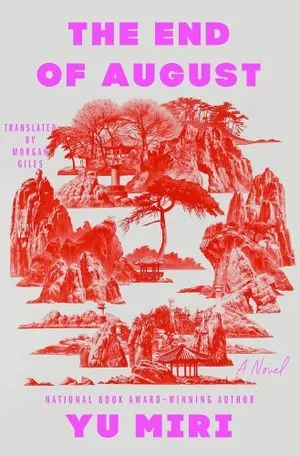
The End of August by Yū Miri, translated by Morgan Giles
In the 1930s, a young man named Lee Woo-cheol is training as a runner in Japanese-occupied Korea. A century later, his granddaughter, herself a marathon runner, engages two mudangs to help her speak to her family’s ghosts (and, hopefully, put them to rest). The vivid book tells a difficult story of Korean history, an emotional tale of unearthing the past, and a rich uncovering of one family’s story.

Pachinko by Min Jin Lee
By now, Pachinko has gathered an intensely loyal fanbase for its rich, careful depiction of history, beginning in Japan in the early 1900s and tracing the life of a Korean immigrant family through decades of its matriarchs’ lives. It’s a powerful story that covers the sociopolitical history of Korea and Japan from 1910 to 1990, while also offering a compelling cast of characters, each with their own ambitions and struggles. This is a much-beloved and acclaimed historical fiction for a reason!
Want more related reading? You’ll want to learn about The Witches of El Paso or maybe consider how accurate historical fiction should really be.
This content contains affiliate links. When you buy through these links, we may earn an affiliate commission.









 English (US) ·