
In the past five years, book bans in the United States have been rampant, wreaking havoc on libraries and schools and impacting authors and readers. I’m a neighbor of Rutherford County, which is in the middle of its own book banning controversy, where, after months of controversy, the library board fired director Luanne James for refusing to move children’s books into the adult section.
Rutherford County is just one of many communities across the U.S. dealing with book bans. From big cities to small, from the U.S. to military regimes, these five graphic novels grapple with the personal repercussions of book bans. What they all show is that oppression often begins with the power of controlling what people read.

Wake Now in the Fire by Jarrett Dapier & A.J. Dungo
Dapier bases this phenomenally written graphic novel on the 2013 banning of Persepolis in Chicago public schools and the subsequent student outcry. Starring a collection of smart, scrappy teens, Dapier shows how book bans impact personal lives and why these teens choose to participate in student protests against them. The teens protest in different ways: some write about their experiences of seeing themselves in books, others take to the streets with protest signs. All of them are needed to end the ban. The graphic novel also delves into the myriad of ways those in authority will lie and obfuscate the truth when banning books.
This is Dapier’s first longer work. He’s previously written picture books, like Mr. Watson’s Chickens, which has been the focus of school censorship. Wake Now in the Fire is a powerfully written, inspiring graphic novel.

Americus by M.K. Reed & Jonathan Hill
This graphic novel captures how small-town moral panic can lead to chaos and book banning. Neal is a budding emo and fantasy book nerd, just entering high school. He and his best friend, Danny, love the same fantasy book series, and they regularly chat with the local librarian about it. Danny’s Christian Mom decides to take issue with the book series when Danny comes out as queer, blaming it for his so-called sins. She raises all hell in the community and rallies a group of similarly-minded people to protest the book series and the librarian at a board meeting. While the characters come off as caricatures, it’s a surprisingly funny read about the real problem of individuals using their religion to deny books to everyone in a community.
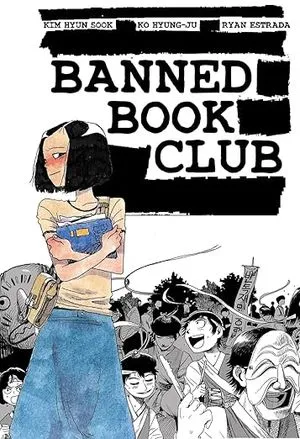
Banned Book Club by Kim Hyun Sook, Ryan Estrada, & Ko Hyung-Ju
Author Kim Hyun Sook based Banned Book Club on her college experiences in South Korea in the 1980s. South Korea’s Fifth Republic was a military regime that controlled the populace through curfews, censorship, torture, and murder. Hyun Sook is the daughter of a restaurant owner and sees college as an escape from her daily life. But from the first day of school, she notices that student protestors disappear or show up to class covered in bruises. She tries to go unnoticed, but when a fellow student invites her to a banned book club, she finds herself hooked.
Hyun Sook and her husband, Ryan Estrada, have a series of graphic novels based on her experiences in South Korea. Their second collaboration, No Rules Tonight, follows the events in Banned Book Club and takes place during a campout in the mountains. It also deals with book bans. They’re both excellent graphic novels about growing up under an oppressive government.
The Stack
Sign up to The Stack to receive Book Riot Comic’s best posts, picked for you.
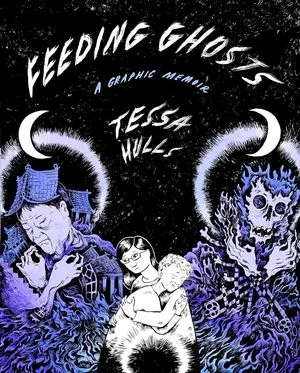
Feeding Ghosts by Tessa Hulls
This gorgeous graphic memoir explores intergenerational trauma among three generations of Chinese immigrant women. It stems from the author’s grandmother’s memoir of escaping Communist China, a book that the Chinese government bans. Sun Yi was a Shanghai journalist targeted for thought control by the communist party. When she finally escapes to Hong Kong after eight years of government torture with her young daughter–the author’s mother–she writes a best-selling memoir about her experience. She also descends into an unbreakable mental illness and is hospitalized. Her daughter, Rose, becomes her mother’s primary caretaker at just 10. Eventually, the two end up in the United States, where Sun Yi continues to write, though it’s mostly gibberish. It’s a beautiful, beautiful graphic memoir, with breathtaking art.

The Boy from Clearwater, Books 1 & 2 by Yu Pei-Yun, Zhou Jian-Xin, & Lin King
I came across this graphic nonfiction duology while researching this list, and was astonished I’d never heard of it. Pei-Yun chronicles the true story of Tsai Kun-lin, who grew up during Japanese and then Chinese rule in Taiwan. When the Chinese occupy the country, Kun-lin is arrested and imprisoned for 10 years because of a brief stint in a book club.
While the first book deals somewhat with book bans, it’s more of a focus in the second book. After his imprisonment, Kun-lin made a name for himself as an editor of popular children’s magazines, manga, and picture books. But the government is constantly censoring his work. Both books are beautifully illustrated in muted colors. They were originally written in three languages — Mandarin Chinese, Taiwanese Hoklo, and Japanese — and are adeptly translated.
If you’re looking for more books that explore the topic of book bans, we have you covered.
This content contains affiliate links. When you buy through these links, we may earn an affiliate commission.





 English (US) ·