
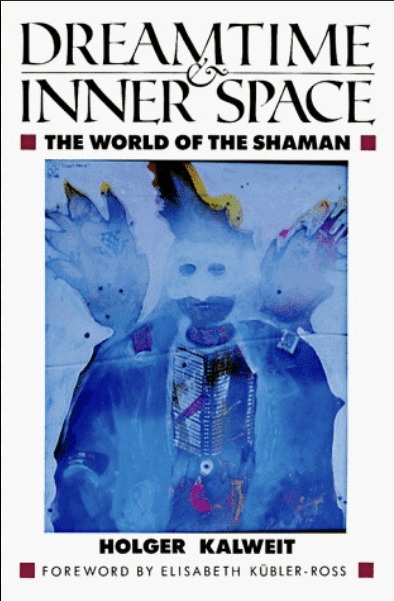
Dreamtime & Inner Space [1988] – ★★★★
“Our scientific methods remain disassociated from actual life, whereas the shaman seizes life by its roots and experiences blazing reality” [Kalweit, Shambhala Publications: 243].
This book may be called a companion piece to Kalweit’s Shamans, Healers and Medicine Men (see my review), and explores how different tribes across the world, from Australia’s Warumungu to Panama’s Guna, view death (afterlife), mortality and soul, and how shamanic rituals, including initiation ceremonies, provide evidence for the communality of all human knowledge and experience. This is a clear, lucid account that provides as much depth as it does breadth.
The author believes that anthropology must become more open to the possibility of the existence of a consciousness that is independent of the physical body: “in every human being there is the possibility of consciousness separating from the body and penetrating the non-physical world of the spirit. Science is not yet in a position to say much about the nature of such an experience” [Kalweit, Shambhala Publications: 58]. Many equate this consciousness to the “spirit” or “soul” of a person, and the shaman, the “specialist of the soul” and the Beyond (the realm of the dead), the “technician of the sacred”, is in prime position to have this experience: “the soul does not leave the body in the event of death; any shaman, if he so wishes, can cause it to part from his own body” [Shambhala Publications: 24]. For ordinary people, such separation can only arise in the event of death, shock, intense fear or other emotion, or in dreams. The shaman may have recourse to certain hallucinogenic plants, fasting or the inducement of sickness to produce altered states of consciousness and bring about the separation. Depending on a belief, this process may take years of preparation, including “purification”, mental discipline training geared towards achieving clarity of thought and complete detachment (the ego loss), so as to journey in the realm of the Beyond and come back safely.
Tribal people report similar out-of-body and near-death experiences to those reported by people living in cities, including a tunnel, meeting a guiding spirit, and “ascending to heaven”. Kalweit cites the research of Osis and Haraldsson who showed that near-death experience does not very across hemispheres and is uniformly present irrespective of cultural differences. “Both myths and subjective experiences of shamans show consistent and unvarying features: helping spirits from the Beyond who escort the soul to the other world; the overcoming of obstacles, rivers, bridges; the presence of the guardian at the entrance to the world of the dead, the feelings of bliss”, etc. [Kalweit, Shambhala Publications: 56]. More recent research now shows that these “shared experiences” may be the product of chemical reactions in the dying brain (there is more activity in the brain when it is closer to death), but even these findings can be interpreted differently – arguing against, and, actually, for supernatural explanations.
Kalweit sounds very persuasive and authoritative, even when making some astonishing claims, and as he digs deep into the esoteric knowledge of the shamans, it is especially interesting to read about how certain tribal groups view this otherworldly place of the Beyond in their imagination. Some view it as an “upside-down” world, not that dissimilar to ours, but with certain things reversed. For example, the Yukaghir people of Siberia hold the view that “we look toward the outside with our eyes in this world, but the dead direct their gaze inward.” The Samoyeds of Siberia also say that, in the Beyond, rivers run “backwards” and the sun rises in the west. I thought these ideas were similar to the idea of parallel universes that is now again gaining popularity thanks to our better understanding of quantum mechanics (for example, the recent study by the University of Surrey uncovered the possibility of opposing arrows of time merging in certain quantum systems).
The author spends quite a bit of time on suffering and sickness as modes to purify the soul in the shamanic tradition (people “wake up” from terrible illnesses and realise what is truly important in life). If in our modern society we abhor sickness and treat it as something undesirable and evil to get rid of, tribal knowledge does not always view it as such, but rather considers it as something normal and even welcoming in the sense of there being a possibility of getting the sick person from one state into a state of the “sacred illness”, and perhaps even into the superhuman mode. Change is not to be feared, but to be understood and accepted. Something extraordinary in a person is not a sign of concern (as we are used to think of it), but of rejoicement.
🦎🦎🦎“...the shaman experiences his sickness as a call to destroy life within himself so as to hear, see and live it more fully and completely in a higher state of awareness” [Kalweit, Shambhala Publications: 91].
🦎🦎🦎
There is a whole chapter on the helping spirits and protective deities of the shaman, and another on the experience of “light” that signals entry to another dimension. I particularly liked the idea here of “sensory poverty” playing the leading role in achieving higher levels of consciousness: “loneliness, uniform landscapes, monotonous behaviour…a meditative state of mind…are prerequisites for higher states of consciousness” [Kalweit, Shambhala Publications: 117]. However, given the title of the book, I also expected more information on shamanic dreamworlds, and on the nature and role of dreams and consciousness levels in the shamanic tradition.
🛖 This is the kind of book that gives much food for thought. Though uneven, and slightly repetitive and disjointed in its second half, it is still an illuminating contribution to the canon of transpersonal anthropology.










 English (US) ·