

Reissued after seventy-five years out of print—and in hardcover for the first time in a generation—David Starr, Space Ranger is the first book in the Lucky Starr series by the legendary Isaac Asimov, author of Foundation and I, Robot. Conway remembered the exact minute the news reached Science Tower. Patrol ships shot into space, attacking the pirates' asteroid lairs in unprecedented fury. They also found something else: a tiny lifeboat between Venus and Earth, radiating automatic calls for help. Only a frightened four-year-old was inside, who said only, "Mother said I wasn't to cry." It was David Starr.
Isaac Asimov is one of the most towering and influential writers in the history of science fiction. Born in 1920, he was an actual scientist: a professor of biochemistry at Boston University. Along with Robert Heinlein and Arthur C. Clarke, he’s considered one of the “Big Three” of science fiction.
He was of a generation of sci-fi writers who put ideas at the forefront. His characters may seem a bit flat and one-note. His plots sometimes drag. But the scientific ideas at the core of his stories were what really mattered. He coined the Three Laws of Robotics all the way back in 1942. His writings dealt with ethics around robots, AI, and galactic political intrigue.
His publication history is long. I mean, so, so long. In his lifetime, he published more than 300 books, many of them short story collections. By his own accounting, he published 1,000 words per day in the first 20 years of his career and more than 1,700 per day in the second 20 years.
This begs the question: Where do you start reading Isaac Asimov?
The Robot Series
Asimov’s greatest contribution to science fiction and, indeed, science, is the Three Laws of Robotics. For that, you need to dive into his Robot series.
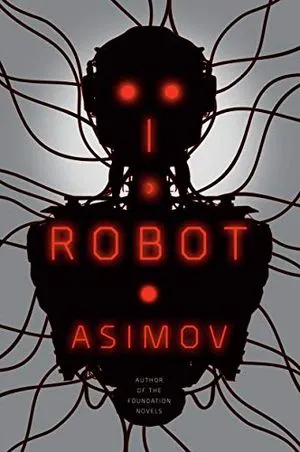
I, Robot by Isaac Asimov
Technically, this book isn’t part of the Robot series, but it’s the precursor to those books. This book collects stories that originally appeared in Super Science Stories and Astounding Science Fiction between 1940 and 1950. And yes, this includes the first mention of the Three Laws of Robotics in the novelette Runaround. Robots and humans must find a new way to coexist to survive, in space and on Earth.
From there, the Robot series continues with Caves of Steel, The Naked Sun, The Robots of Dawn, and Robots and Empire. However, I’d recommend saving that last one. You have a couple of other Asimov stories to cover before we get there.
Foundation
If you’ve watched the recent Apple TV+ series, then you’re familiar with Asimov’s big, sweeping space epic series, Foundation. The publication order doesn’t match the series order here, so you want to start with Prelude to Foundation, then Forward the Foundation, before you read.

Foundation by Isaac Asimov
Originally written and published as short stories, Foundation imagines the decline of a massive galactic empire, akin to the fall of the Roman Empire. Each of these successive stories (chapters in the book) represents a leap forward in time, showing the slow, inevitable collapse of the empire and the rise of a new one.
The original Foundation Trilogy continues with Foundation and Empire, then Second Foundation (the second empire). Later, Asimov expanded on this series with Foundation’s Edge and Foundation and Earth.
You should also read Robots and Empire between those last two Foundation novels for maximum effect.
The Best of the Rest
There really is so much great stuff to read from Asimov. But again, that whole list can feel overwhelming. Asimov’s only Hugo Award win during his lifetime was for The Gods Themselves, which focused on two Earths in parallel universes and those trying to exploit the differences in their physical laws. This book also won the Nebula Award, making it Asimov’s most decorated work.
There are two other great novels based on shorter works by Asimov that bubble up to must-read status: Nightfall and The Positronic Man. The former, cowritten with Robert Silverberg, is set on a planet with multiple suns that knows no darkness. That is, until a rare full eclipse occurs, sending the planet into chaos. The latter was the basis for the movie Bicentennial Man, about a robot that begins to display very human characteristics, eventually fighting for his rights to be recognized as his own person.
This primer provides a roadmap of Asimov that covers 16 books. Still, that leaves hundreds of Asimov books and thousands of short stories. What are some of your favorites that didn’t make the list?
This content contains affiliate links. When you buy through these links, we may earn an affiliate commission.










 English (US) ·