
Liberty Hardy is an unrepentant velocireader, writer, bitey mad lady, and tattoo canvas. Turn-ons include books, books and books. Her favorite exclamation is “Holy cats!” Liberty reads more than should be legal, sleeps very little, frequently writes on her belly with Sharpie markers, and when she dies, she’s leaving her body to library science. Until then, she lives with her three cats, Millay, Farrokh, and Zevon, in Maine. She is also right behind you. Just kidding! She’s too busy reading.
Twitter: @MissLiberty
Hello, my little moss spores! In today’s round-up of recent sci-fi and fantasy links, I have stuff to share about what works in time travel stories, a new short story from Stephen Graham Jones, thought-provoking science fiction movies, and more!
If you’re looking for fabulous cover reveals, check out The Rainshadow Orphans by Naomi Ishiguro and The Inn at the Foot of Mount Vengeance by Chiara Bullen. Also, in case you haven’t heard, Daniel Kraus is releasing his first sci-fi novel next year. It’s called The Sixth Nik, and it comes out June 9, 2026. I just got it, and I am SO excited, because his novel Angel Down is one of my very favorites of 2025.
Read an Excerpt of As Many Souls as Stars by Natasha Siegel
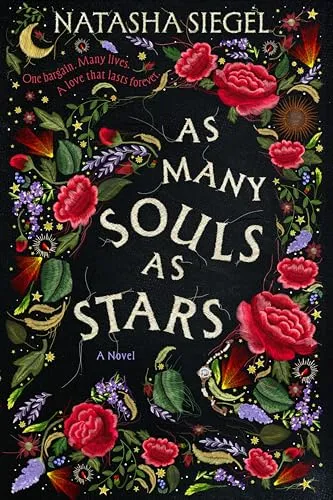
One of the year’s exciting romantasy novels is As Many Souls as Stars by Natasha Siegel, a queer, gothic tale about a witch and an immortal demon, bound through time. Cybil is an unhappy, cursed young witch in the sixteenth century who meets Miriam, a demon who survives on souls. The two strike a deal: Cybil’s soul for reincarnation and a chance to be rid of the curse. So for each lifetime, Miriam shows up to claim Cybil’s soul, and slowly through the centuries, their bond grows as the power struggle shifts.
Swords and Spaceships
Sign up to Swords and Spaceships to receive news and recommendations from the world of science fiction and fantasy.
You can read an excerpt from this exciting novel on Reactor, and get a taste of it below!
“Cybil Harding was born on Christmas Eve, 1576, under inauspicious stars. Her father had drawn the chart himself; it told him that his daughter was destined for an early death, that she would bring calamity to those she loved and those who loved her. But that was hardly surprising, after all. She was a First Daughter, and a First Daughter was always cursed.
It was clearly laid out in the family grimoire, passed down between generations of Harding witches and written in ink that was no longer blood but might once have been: the firstborn child of each Harding generation would be a witch. But if that witch was a girl, then the grimoire was very clear. No woman could bear the weight of such power. She would be tainted, her magic uncontrollable, bringing disaster to all those around her.
Some would call the Harding inheritance evil, even Satanic. The grimoire spoke of dealings with shadows, a dark bargain made in years forgotten that had traded pieces of each heir’s soul for power. But Cybil’s father, a witch himself, refused to believe his ancestors would have made such a pact. Christopher Harding, a man of the Renaissance, saw his unusual inheritance as an angelic blessing. What else could such magic be but a heavenly gift?
The Hardings were an ancient family—a line that may have once been truly venerable, before the rumors began that they dealt with the dark. They had owned their land since time immemorial, had built their great houses on the same Suffolk hill, over and over, through myriad cycles of destruction: walls of daub and lumber and stone falling to war, flood, and flame; the tenants of their village dying from invasion, plague, and famine; and yet, still, they persevered. Now their walls were brick, they had the favor of Queen Elizabeth, and the village prospered once more after decades of failed harvests.
What Works in Time Travel and What Doesn’t
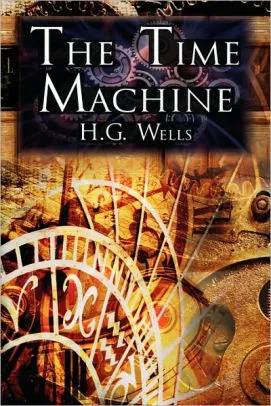
Mind Matters recently shared an interesting five-part series of articles about time travel in depth in science fiction, in which writer Gary Varner discusses good and bad examples.
“Over the last several months, I’ve been covering the time travel trope in science fiction movies. Its modern manifestation began with H.G. Wells’s novella, The Time Machine (1895) and the film interpretations it later inspired, along with the botched Terminator franchise. In this series of articles, I would like to explore the concept of time travel itself in more detail. My goal is to show what does and doesn’t work when it comes to time travel and why. How can a writer use the trope skillfully and what should the writer avoid.
Why do viewers accept a story premise?
I believe that the suspension of disbelief, which is one way to measure the quality of a story, is driven by stakes, that is, why the audience should care. This is also sometimes called the story question.
Stakes are manifested by clarity. I’ve recently been reconsidering my position on stakes. I am entertaining the idea that clarity is really the prime criterion for a believable story. It may even be what makes a story good or bad.
In my experience — especially while writing these Sci-Fi Saturday reviews — I’ve come to realize that plot holes always sprout in ambiguity. Usually, the writer has ignored something. He or she wants a visual or a particular outcome or a message and rushes to get to that point, leaving various matters unaddressed.”
Story Time! “The Belle of the Ball” by Stephen Graham Jones
Speaking of time travel: Reactor recently shared a frightening sci-fi short story from esteemed horror author Stephen Graham Jones, and it’s awesome. “The Belle of the Ball” is about a future where traveling to the past has no consequences, and one young man who can only afford to go back two years, but it should do the trick for what he has planned.
From the story:
“Gray doesn’t understand the temporal mechanics perfectly, but he’s pretty sure he understands them good enough: any past you go back into, the universe or ‘physics’ or God or whatever protects itself from interference by making the past you’ve gone back to a sort of parallel branch, a side room, a curiosity where all lives are fake, at least when compared to the real ones happening in the universe you time-traveled from.
First, this means that paradoxes are, technically, possible—things are fixable, or ruinable—but in order to ever get wrapped up in one of those backbendy stories, you would have to somehow wriggle back into time without the universe noticing you. Which either no one has done so far, or everyone already has, resulting in the mess society and the climate and politics and everything else is.
But?
Gray knows probably nobody’s messing with things. All the things broken in his world can’t be traced back to this or that despot living or dying, or some random butterfly either flapping its wings or getting stepped on before it could—they’re just the result of, you know, humans humaning, shooting their own feet every second or third step, then limping ahead to do it again, any and all lessons woefully unlearned. How the species has made it far enough to come up with time-travel tech, much less commercialize it, is the biggest mystery of all to Gray.
You can read it all on Reactor!
And, To Close, a List! Collider’s 10 Most Thought-Provoking Science Fiction Movies of the Last 10 Years
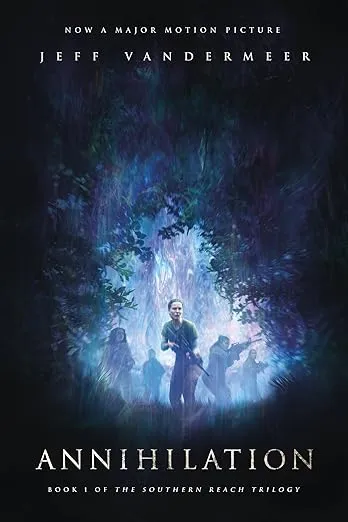
If you like your sci-fi films to be think-y, check out these selections of the 10 most thought-provoking sci-fi films of the last decade. There were a few that I expected—Annihilation, Ex Machina, The Arrival—but also a couple I hadn’t even heard of, like After Yang. Just like novels, I don’t need to understand what is going on in a movie, as long as it’s entertaining. I think I need to treat my brain to a boost and check out a few of these! Which ones have you seen?
Okay, star bits, now take the knowledge you have learned here today and use it for good, not evil. If you want to know more about books, I talk about books pretty much nonstop (when I’m not reading them), and you can hear me say lots of adjectives about them on the BR podcast All the Books! and on Bluesky and Instagram.
If an SFF fan forwarded this newsletter to you or you read it on bookriot.com and you’d like to get it right in your inbox, you can sign up here.
















 English (US) ·