
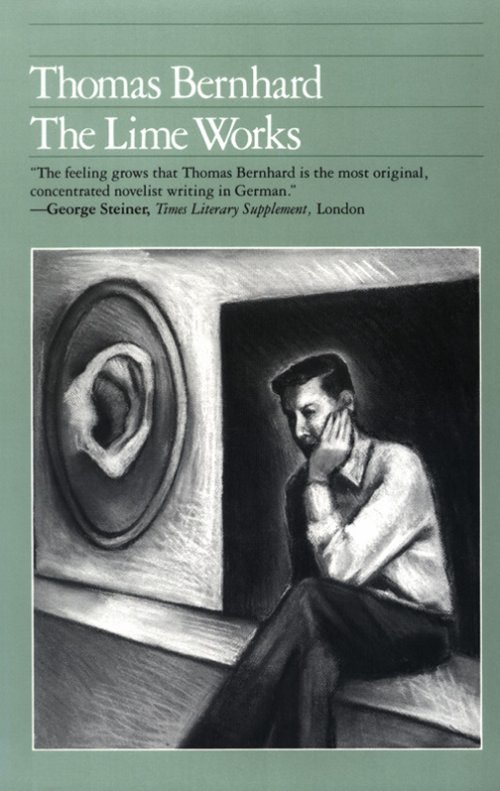
The Lime Works [1970/1986] – ★★★★
“I am interested only in “nonsense”; only in that which makes no practical sense. I am interested in life only in its absurd manifestations.”Daniil Kharms
“The absurd is the essential concept and the first truth.” Albert Camus
The Lime Works is a slowly suffocating narrative with a cobweb-like structure, inside which one can find both a spider (“monster”), Konrad, a man with peculiar obsessions, and its caught wrapped prey (“victim”), Konrad’s loyal, but disabled wife Zryd. Both have moved into a very expansive, but, paradoxically, also claustrophobic lime works in the town of Sicking, Austria, and have lived there in relative seclusion. Konrad’s sole purpose in life has revolved around his strange auditory experiments with which he pesters his wife incessantly so that his dream materialises – the finishing of his book titled The Sense of Hearing. He fantasises about the conclusion of this task even as he is still to write the book’s first sentence. Then comes the horrifying murder. What happened, and how the man with such abundant academic ambition living apparently peacefully could have gone so wrong? The writing, with its restlessness and peculiarly Bernhardian anxiety, crafts a tale of obsession, expectation and one quiet, horrifying descend into madness.
The Lime Works is the most existentialist novel of the author I have read so far. It can be described as the author’s novel Concrete (artistic procrastination) meeting (+) Bernhard’s Correction (impossibility of perfection). Written from the point of view of one insurance salesman who spreads hearsay, the affairs of Konrad and his wife are retold with varying degrees of trepidation, amazement, confusion, disgust, and intense curiosity. Various impressions become indistinguishable from concrete facts, shrouding the main character and his eccentric actions in mystery.
One prominent theme of the book is the complexity of obsession. Once obsession has emerged, there is no end as there was never any beginning. One is always lost in a moment that seems to stretch infinitely, at least a lifetime:“it is in the nature of a mania that a man will give his entire life to it and destroy himself entirely by his obsession alone and nothing else” [Bernhard/Wilkins: 1970/86: 39]. Konrad had always wanted to buy the lime works, obsessing over it for years, so that he could settle in it and write his book. This book and his hearing experiments are also part of his maniac pursuit of the unreachable, non-existent perfection. Bolting all the doors and barring all the windows, he tried to isolate himself from all the external noise and environment to focus on his book, but, in the end, it is not this writing task that starts to shape him beyond all recognition, but rather his procrastination, his expectation of starting the said task. The devilish web is spanning of its own accord as Konrad gets lost in inconsequential matters, trivialities, and in a multitude of distractions. And, he is growing increasingly paranoid, being armed to the teeth in the place to which few ever ventured. As with many Bernhard characters, their main enemy is their own mind.
Early on, we have a hook in this story – how did the senseless murder of Konrad’s wife come about? But, Bernhard does not give us easy answers. The truth, macabre excitement, mystery is in the question itself, not in the answer. It is the unanswered question that drives the life (narrative) forward, propelling the artistic potential, deepening the enigma. Indirectly, the author talks about tormented artists, commenting on the individual creation boarding genius vs. demands of the masses battle, the two unbridgeable opposites designed to hurt each other and not coexist. The individual genius is considered a threat to the comfort of the masses, and the whole point becomes to either mould that individual to the taste of the masses or expel him to the outskirts of obscurity. Konrad willingly chooses the latter, at a considerable cost, proving the futility of all ambition: “Nothing is ever mastered, everything is misused” [Bernhard/Wilkins: 1970/86: 81]. His creativity is stifled by unexplained illnesses, daily trivialities and domestic conflicts. The hell is always the other people, as Sartre put it, but loneliness still bites like hell.
Absurdity is at the core of Bernhard’s novels. Once one gets this – everything else falls into place, or rather expectedly – out of place. And, that is alright, that is the point. Chaos reigning in the guise of the highest of orders. Like in the works of Kafka, the pretence of the order and logic are there to camouflage the complete bedlam. It rules the heart and mind of Konrad, just as it rules the outside world in Kafka’s The Trial. As for Bernhard’s beloved contradictions, one doesn’t fight them, one makes peace with them: “the unintentional is the intentional, the most unintentional the most intentional”,“everything is strange on the one hand and not at all strange on the other“. Bitter and apathetic Konrad is also full of those contradictions. He is both arrogant and full of doubt, ambitious and full of ideas, and mentally impotent, strong and weak. But, his true rebellion is paradoxically his precise inaction – to start and carry on writing his book. And, when he finally does the action…it is the action that is the worst that a human being is capable of, a kind of an act that automatically removes him from society. Both he and his wife have started to concern themselves so much with sound and hearing in their environment of near-complete isolation, that they ran into a wall – the wall of eternal silence.
The lime works in the story, as the cone building in Bernhard’s novel Correction, may symbolise and represent many things, such as obsession, destructive love, and the futility of perfection, but similar to Knut Hamsun’s works, it may also stand for the mystery of the human soul and mind, and the outsiders’ limited perception of the nature of that essence and its potential. This is completely incomprehensible to anyone, but the possessor (the person living inside the lime works): “But anyone stepping suddenly from behind the surrounding thicket to confront the lime works could not possibly have any conception of its vastness, such as was reserved only for the man who lived inside, inhabited the place head and soul…and therefore able to sense all of its true extent. Not grasp it, exactly, but get the measure of it…An onlooker would be irritated, a visitor offended; while the onlooker would be both attracted and repelled by the lime works, a visitor was bound to suffer immediately every kind of disappointment. Whoever sees the place will turn around and take to his heels…” [Bernhard/Wilkins: 1970/86: 44]. Bernhard frames the human mind and its potential as this labyrinthine structure similar to a spider’s web or a labyrinth with the Minotaur in it. It runs on its own mad logic, having many mirrors, traps and doors, leading to the core – the seed of human consciousness? It is only really known to the person possessing that mind/structure and, sometimes, not even to him and never in its entirety. That person can make it either hell or heaven, and through it, achieve great or terrible things, or simply succumb to futile, lifelong inaction.
Bernhard’s writing style, with its repetitions, digressions and cynical wording matches well the equally maddening character and the story. The voice, with its caustic complaints, lamentations, and its sense of moral personal superiority, is the objective, and what it tells about is only secondary. The unrelenting blocks of text without a paragraph break in sight to alleviate tension or catch one’s breath are seemingly there by design – to frustrate, exasperate, but also intrigue and confound. The narrative does not clarify, it only deepens the enigma, expanding on the complexity and growing in one restless crescendo movement, like a noose getting tighter, like a death struggle to get to the meaning of life before it is too late. It is bleak and progressively Kafkaesque, but also mentally-stimulating as it muses on the meaning of existence (“our very existence is pure self-deception”), the mundane, and the infinite. Bernhard’s novel will disturb the comfortable and comfort the disturbed.
In the story, Konrad’s wife Zryd gets frailer and more incapacitated with each passing day, the appearance of handyman Hoeller, who brings food and news to the couple, only starts to annoy Konrad, and his own health starts to fail. The ending could have been more satisfying, but in a typical Bernhardian fashion, the frustration, abruptness and even pointlessness are exactly the point.
𖦹 One doesn’t read Bernhard, one survives him. The Lime Works is one of those books. The intensely cerebral, quasi-philosophical diatribes hide much profundity if one is willing to probe further. There is much sense in all the nonsense, and much nonsense in the apparent sense. This is for those readers who love to be pulled into the vortex of a prose characterised by situational tragi-comedy and the absurdity of everyday existence.








 English (US) ·