
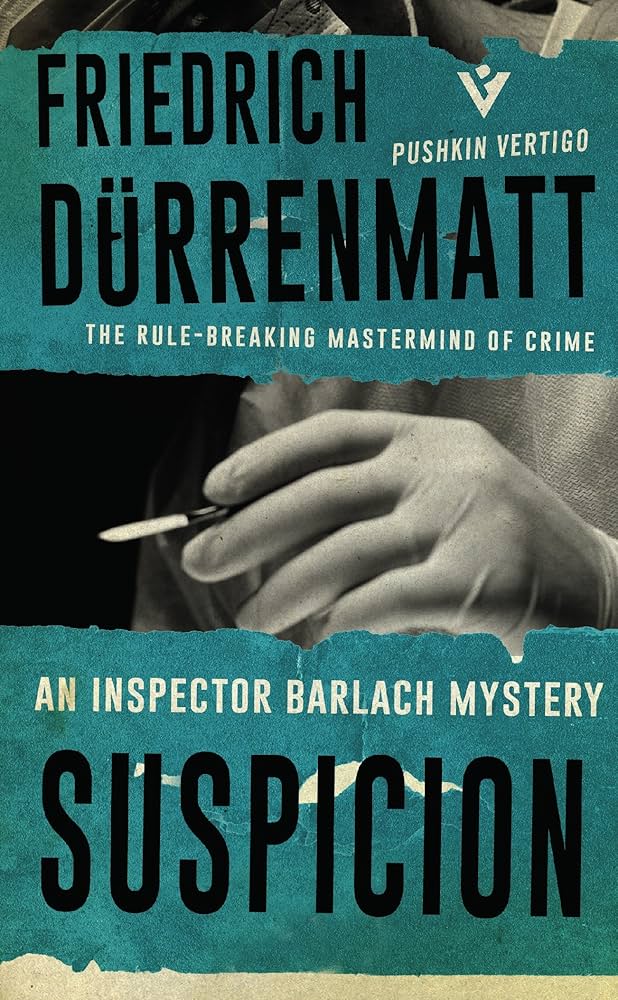
Suspicion [1952/2017] – ★★★★
“Suspicion is a terrible thing, it comes from the devil. There’s nothing like suspicion to bring out the worst in people” Dürrenmatt/Agee [1952/2017].
Inspector Barlach is terminally ill, staying at a hospital in Switzerland where one day his friend points out to him that one photo in a medical journal resembles a man he used to know – Dr. Emmenberger. However, the photo caption says that this is known Nazi doctor Nehle, responsible for countless deaths. So, how is it possible for two people to be so similar in their appearance? The Nazi doctor (Dr. Nehle) supposedly poisoned himself in 1945, and the man known to Barlach’s friend now runs a successful clinic whose patients leave him property after their death. That’s suspicious. What if the identities were switched? Could it be that this ex-Nazi never actually killed himself and is now possibly killing off his patients for their property? Barlach reckons that the only way to find out for sure is to become Emmenberger’s patient, but that soon proves risky. In no time Barlach is drawn into a dangerous cat-and-mouse game and at stake is possibly his own life (or what is left of it). Can he expose the man for what he is before that man gets the chance to silence him forever? Dürrenmatt is at the top of his form in this novel: succinct, philosophical, and endlessly thought-provoking.
The first part of the book is Inspector Barlach uncovering more information about the mysterious photo, and, miraculously, many sources of information land in his lap. His doctor friend knew Emmenberger when both were medical students and one eccentric Jewish man even met Dr. Nehle in a concentration camp and is now dying to share with Barlach all that he knows. The second part of the book finds Barlach in a clinic run by Emmenberger, and while there, Inspector meets Doctor Marlock, a beautiful woman and, quite possibly, Emmenberger’s lover and accomplice in crime.
The Second World War hangs over the plot like a shadow, seeping everywhere, while the characters mull over trauma, guilt, justice and common responsibility. Barlach’s goal to secure justice and prevent future deaths at the hands of Emmenberger becomes almost a symbolic attempt to reverse the horrors of war and try to come to terms with its most horrifying conclusions, including about the human nature. Barlach is in for a rude awakening if he thinks that any idealistic efforts and hope can suddenly erase the past and bring back the stolen peace and blind faith in humanity, as Doctor Marlock declares: “The earth can no longer be made into a paradise, the infernal stream of lava we conjured up in the blasphemous days of our victories, our fame, and our wealth…Only in our dreams can we win back what we have lost, in the radiant images of longing that can be attained with morphine.”
As with most Dürrenmatt’s other fiction, what we read is never just a crime novel or a thrilling mystery, but also an exposé of the human nature, and with Barlach’s end being near, the story is full of urgency and existential revelations. “There is only one difference between human beings: the difference between the tormentors and the tormented”; “Sometimes freedom is a whore, sometimes a saint, she’s different for each person, one thing for a worker and another for a priest, another yet for a banker, and different again for a poor Jew in a death camp.”
The story is elegantly construed, but unbelievable in places, and that lessens its power. That impression lasts until the last chapters where we finally have the answer to all the incredulous material – the story is an absurdity, the peculiarly Durremattian absurdity, with a bold, larger-than-life villain and “extreme final turns”.
💉 Dürrenmatt keeps his reader on a tight leash in his story as he unveils cruelty hiding in the apparent benevolence, and evil lurking beneath the visible respectability. This is a mystery with myriad speculations, intense psychological mind games, precise pacing and unusual plot.
🔍 See also my short reviews of Friedrich Dürrenmatt’s other work – The Visit, The Tunnel, Traps, & The Meteor.





 English (US) ·