
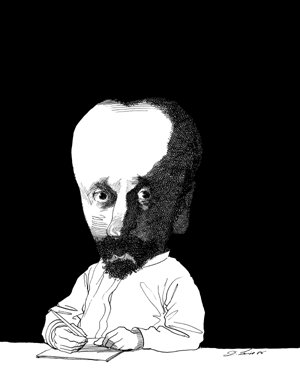
Scholars speak of two Mikhail Bakhtins—on the one hand, there is the author of Rabelais and His World (published in 1965, though he began writing it in the 1930s) and, on the other, the author of Problems of Dostoevsky’s Creative Art (1929; revised as Problems of Dostoevsky’s Poetics, 1963), the essays on the novel in The Dialogic Imagination (1975), and various philosophical works. Since Bakhtin first became widely known in the 1980s, his book on Rabelais has occupied a perplexing place in his oeuvre because it seems to contradict just about everything else he wrote. Bakhtin’s other works focus on our “unrepeatable” individuality as the source of all morals and values, whereas the Rabelais book makes fun of everything of concern to individuals and celebrates instead the collective. Students of Adam Smith who wonder at the apparent discrepancy between his two masterpieces, The Wealth of Nations (1776) and The Theory of Moral Sentiments (1759), often consider the “Adam Smith problem”; in much the same way the Rabelais book poses a “Mikhail Bakhtin problem.”
Rabelais and His World has a complicated history. As Sergeiy Sandler explains in the preface to his new scholarly translation of the book, in the mid-1930s Bakhtin lived in internal exile in Kustanay, Kazakhstan, to which he’d been banished in 1929 after his arrest for alleged involvement in an underground Russian Orthodox study group, the same year he published his first masterpiece, his book on Dostoevsky. Begun in 1938, the Rabelais book was finished in 1940 but not published. After the war, when Bakhtin was teaching world literature at the Mordovia State Teachers College in Saransk, he submitted it as a doctoral thesis. At first the study seemed impressive enough to earn not the degree equivalent to our Ph.D. (kandidat nauk) but the higher degree doktor nauk, roughly equivalent to a full professorship. After a complex series of events, including a hit piece directed against the institute that called Bakhtin’s book “a pseudoscientific dissertation, Freudian in its methodology,” and several revisions on Bakhtin’s part to make the study ideologically acceptable, he received the lower kandidat degree in 1952.
When a group of scholars who admired Bakhtin’s Dostoevsky book discovered to their amazement that the author had survived the purges in a remote town, they arranged to have his many manuscripts published. These included not just the Rabelais book but also an expanded version of the Dostoevsky study, book-length essays on the novel as a genre, and shorter essays on language and interpretation. Also discovered were two strictly philosophical works, Art and Answerability (1919), a treatise concerning the self’s relation to itself and others, and Toward a Philosophy of the Act (1919–1921), which examined the nature of ethical responsibility. It soon became apparent that the Dostoevsky book developed ideas first broached in the philosophical treatises.
Reflecting his neo-Kantian training, Bakhtin’s earliest works focused on the significance of the soul’s embodiment in a particular time and place, as well as the ethical demands on a person in the “unrepeatable” here and now. Concerned with how people try to avoid their obligations, he diagnosed a syndrome common in Russia: pretending that one is simply acting “representatively,” that is, as the agent of some church, institution, or party that is actually responsible for one’s actions. For Bakhtin, such excuses are always false. People must take responsibility for—in Bakhtin’s terms, they must “sign”—their actions. Responsibility can be neither postponed nor passed on to others because what “I” can accomplish now cannot be accomplished by anyone else. All “alibis” for responsibility fail because, in Bakhtin’s famous phrases, “there is no alibi” and people live in a state of “non-alibi.” When Bakhtin turned his attention to Dostoevsky and other realist novelists, he found these ethical tenets implicit in the very shape of their stories.
Since Bakhtin’s two philosophical treatises were the last to be published and translated, critics, especially in the West, have usually failed to appreciate how his literary criticism doubled as philosophical exegesis. Bakhtin was by no means the first Russian critic to mask philosophy as literary analysis. Before the revolution, almost all the greatest Russian thinkers did so, partly because Russians regarded literature as the most important cultural activity and partly because censors might overlook political ideas disguised as merely literary ones.
Bakhtin’s best-known works lend themselves to being read either as literary criticism using philosophical ideas or as philosophical arguments illustrated by literature. Which of these readings was primary to Bakhtin himself? When Victor Duvakin, in a series of interviews conducted with Bakhtin shortly before his death in 1975, asked whether he considered himself a philosopher or a literary scholar, Bakhtin replied without hesitation: “A philosopher. And that’s who I am to this day.”
As Caryl Emerson notes in her superb foreword to the present volume, all Bakhtin’s works contribute to a coherent philosophical position, except the Rabelais book. In contrast to the earlier version by Hélène Iswolsky (1968), Sandler’s translation favors literalness—often wisely but sometimes at the expense of clarity. Where Iswolsky refers to the “bodily lower stratum” (for the Russian niz), Sandler renders the Russian opaquely as “the nethers”; and so the title of chapter 6 becomes the puzzling “Images of the Material-Bodily Nethers in Rabelais’s Novel.” The new version contains more than a hundred pages of notes, often on subjects so abstruse that even the most devoted Bakhtin scholar would skip them. Still, Emerson’s engaging foreword effectively orients first-time readers while offering insightful ideas for the specialist. The discrepancy between the Rabelais book and Bakhtin’s other studies has mystified Bakhtin scholars. Some who applaud one Bakhtin find the other unconvincing or even repellent. The new translation, coming some fifty-seven years after the first, offers an occasion for examining whether the discrepancy is as great as it has seemed.
In the Dostoevsky book, the studies of the novel, and the early and late philosophical essays Bakhtin argued for human freedom. People can never be reduced to causal, “historical-genetic” factors. No matter how much we know about a person, he or she retains the capacity to “surprise,” and this “surprisingness” constitutes the essence of humanness. Take that away, and you transform people into material objects.
As Bakhtin presents him, Dostoevsky discovered an entirely new way to foreground “surprisingness” and show people as maximally free. In most great novels, even those that endorse human freedom, readers cannot help seeing characters as constrained by the overall plan, designed by the author in advance. Characters may imagine they act freely, but the reader unavoidably knows that they must do what will create a structurally satisfying work. That is why readers, as they see a novel approaching its ending, can often guess where events are leading. In effect, characters are subject to a form of backward causation, as the predesigned end dictates what they will do to reach it; their actions are, so to speak, not only pushed but also pulled. The very fact that the author knows the character’s future as the character cannot—that the author has what Bakhtin calls an “essential surplus” of meaning—renders freedom and suspense illusory.
Dostoevsky discovered a way around this problem, which Bakhtin regarded as not only formal but also philosophical and theological. To show people as truly free, Dostoevsky surrendered his “essential surplus.” The author no longer exists above the characters but alongside them. He sets up situations that will provoke characters to act and then just sees what they do. There is no overall structure to fulfill, no ending with strong closure toward which events tend. What happens is what happens to happen.
When Dostoevsky submitted the first installment of The Idiot (1868–1869) to the journal in which it was serialized, he had no idea what would happen next. As this compulsive gambler wrote in one letter, “I took a chance, as at roulette. Maybe it will develop as I write it.” As the roulette player cannot predict the outcome of his bets, so Dostoevsky, as he himself emphasized, did not know (even unconsciously) where the work was going. To indicate as much, he made the plot turn on events in the real world that took place between installments—events that couldn’t have been part of an original plan with a foregone conclusion.
Somewhat misleadingly, Bakhtin calls this new technique “polyphony,” not because the work blends many voices—all novels and dramas do that—but because the author’s voice becomes just one among many. Rather than construct a dialogue that he controls from outside, he participates in it, with no guarantee that his point of view will triumph. Often enough, it doesn’t. In The Possessed (1871–1872), for instance, the character closest to Dostoevsky’s own opinions—about Russia’s God-given destiny—eventually recognizes them as simplistic. Since the author becomes one voice among many, the way Copernicus decentered the Earth and made it just one of many planets, Bakhtin credits Dostoevsky with “a small-scale Copernican revolution.”
Works written this way are bound to contain loose ends, and critics have faulted Dostoevsky’s novels—especially The Idiot—for such lapses. But these irregularities are lapses only if one presumes that successful works must have an overall structure and constitute a finished product in which everything fits and nothing is superfluous. To understand Dostoevsky, one must appreciate a fundamentally new poetics—the polyphonic novel’s poetics of process.
In most novels, suspense is illusory, since the author knows, and is presumed to know, what is coming next. The peculiarly intense suspense experienced by Dostoevsky’s readers reflects the fact that the author has no more knowledge of the future than the characters do. The suspense is genuine. That is why events in Dostoevsky’s novels can evoke what Bakhtin calls “eventness.” The Idiot is an extreme case, but all Dostoevsky’s novels are more or less polyphonic in this way (or so Bakhtin, with some exaggeration, maintains). Each novel constitutes a freewheeling, unplanned “great dialogue” that takes place, and is sensed as taking place, “right now…in the real present of the creative process.”
If God made the universe the way Dostoevsky created his novels, then people would be genuinely free. Bakhtin did not seem aware of twentieth-century “process theology,” but he arrived at some similar conclusions. We may recall that Bakhtin had been arrested for participating in a circle studying Russian Orthodoxy. It seems likely that, although unmentionable in the officially atheistic state, theological parallels to his literary ideas were never far from his mind. If so, then Bakhtin’s God deliberately creates people who are capable of surprising him. In such a world divine omniscience allows God to know everything that has happened but not everything that will happen, precisely because contingency and human freedom always allow many possible futures. In the Soviet Union, of course, Bakhtin could not offer theological arguments or speak of the Christian God, so he invokes the Greek pantheon: “Dostoevsky, like Goethe’s Prometheus, creates not voiceless slaves (as does Zeus), but free people, capable of standing alongside their creator, capable of not agreeing with him and even of rebelling against him.”
Bakhtin regarded literary genres as so many different ways of understanding human experience. Forms do not define genres but result from worldviews seeking appropriate expression. A genre is what Bakhtin calls “a form-shaping ideology.” Regarding the realist novel as the most sophisticated understanding of life ever developed, he characterized its form-shaping ideology variously—by its view of language, its understanding of human agency, its idea of how social conditions shape personalities, and its attitude to received truths. Together these characteristics convey a complex sense of personhood that shapes, and is shaped by, the social world. Novelistic plots differ from those of other narrative genres because each genre presumes its own sense of individual agency. While ancient Greek romances, for instance, depict characters as buffeted by fate and show life’s vicissitudes as so many trials to endure, novels stress people’s relative freedom to make their own choices. Because ethical responsibility entails freedom, novels convey an especially rich sense of our moral lives—the sense described in Bakhtin’s early treatise on ethics.
Above all, novels emphasize individuality, the way each personality differs from all that have been or ever will be—a difference Bakhtin calls “unrepeatability.” The personality is also “unfinalizable” in that it can always develop in surprising ways. It is never complete. Novels presuppose that people, unlike objects, cannot be exhaustively understood, and so Bakhtin’s first principle of ethics is: never treat another human being as wholly knowable and predictable, even in principle. The great social scientific systems presume that some set of causes shapes everything we do and think, including our mistaken idea that we choose freely. They contradict the worldview Bakhtin attributes to realist novels, especially Dosoevsky’s, as he writes in the Dostoevsky book:
As long as a person is alive he lives by the fact that he is not yet finalized, that he has not yet uttered his ultimate word…. A person never coincides with himself…. The genuine life of the personality takes place at the point of non-coincidence between a person and himself, at his point of departure beyond the limits of all that he is as a material being, a being that can be spied on, defined, predicted apart from its own will, “at second hand.”
When you have applied all possible categories to a person—social class, nationality, historical period, ethnicity, even personality type as shaped by years of experience and patterns of behavior—there is still something left over. It is this “surplus,” as Bakhtin calls it, that makes a person human. As he explains in “Epic and Novel”:
An individual cannot be completely incarnated into the flesh of existing sociohistorical categories. There is no mere form that would be able to incarnate once and forever all of his human possibilities and needs, no form in which he could exhaust himself down to the last word…no form that he could fill to the very brim, and yet at the same time not splash over the brim. There always remains an unrealized surplus of humanness; there always remains a need for the future.
How different all of this seems, at first glance, from Bakhtin’s Rabelais book! There everything is about wonderful collectivity, not individuality; it is about the people as a whole. Any view that values “the egoistic bourgeois individual” is exposed as shallow. Rabelais’s works, as Bakhtin describes them, express the worldview of carnival, which is not only a collective festival but also a festival celebrating collectivity. The profound significance of Rabelais’s novel is that it conveys, better than any other book, the carnival sense of life.
Bakhtin traces the history of carnival from the ancient Saturnalia to medieval festivals, which, he tells us, sometimes occupied several months of the year. In carnival, authority is overthrown or inverted, so that kings become beggars and beggars rule. Everything is turned upside down and inside out. Liberated from official culture, people in carnival indulge in mockery, blasphemy, overeating, and sexual license. Every “thou shalt not” becomes “thou shalt.”
Carnival and Rabelais ridicule whatever is solemn, hidebound, and forbidding. Carnival is ultimately about laughter, understood not just as a physiological response but, like literary genres, as a whole view of life. Life perceived through the eyes of laughter could not differ more from life understood by deadly serious official “agelasts” (those who do not laugh). We find the laughing view of life in other Renaissance writers—in Shakespeare, Erasmus, and Cervantes—because the Renaissance, as Bakhtin understood it, was deeply affected by the carnival sense of the world. “The Renaissance attitude toward laughter,” Bakhtin explains,
can be roughly and preliminarily characterized thus: laughter has a deep philosophical meaning; it is one of the most essential forms of truth about the world as a whole, about history, about the human being; it…sees the world differently, but no less (and perhaps more) essentially than does seriousness…. Certain utterly essential aspects of the world are accessible only to laughter.
Because carnival celebrates collectivity, individual death is not taken seriously. There is no frozen tear. After all, the people as a whole are immortal, and death is always accompanied by new birth. Carnival suffering renews and is never the occasion for sadness. As in a cartoon, the endless violence in Rabelais’s stories is never seen through the perspective of an individual in pain. The focus is always on the collective and on laughter itself.
For the same reason, fear—the fear experienced by a specific person—does not exist in carnival or in Rabelais. That is why carnival grotesque does not resemble Romantic grotesque. With its emphasis on the individual soul, “the Romantic grotesque may express fear of the world and seek to inspire this fear in [its] readers.” By contrast,
the grotesque images of [carnival] folk culture are absolutely fearless and make everyone partake in their fearlessness…[which] is also characteristic of the greatest works of Renaissance literature. But the apex in this respect is Rabelais’s novel: here fear is annihilated at its very origin and everything has turned into merriment. It is the most fearless work in all of world literature.
So long as one understands the body as the fragile and vulnerable envelope of the individual soul, physicality entails fear. To distract from this fear, individualistic cultures focus on the body’s strength and beauty and on everything as far from the grotesque as possible. Aristotle regarded the soul as that which gives form to bodies, and in what Bakhtin calls the classical image of the body nothing escapes that forming power. Whatever does, whatever calls attention to what goes on inside the body or is expelled from it, evokes disgust.
Classical bodies do not defecate, sweat, or vomit. Those functions take place offstage, privately, concealed from others. Each body is separate and self-contained, and nothing escapes the soul’s control. Materiality is redeemed, and so suffering and death are overcome: “The body [so conceived]…is first of all a strictly completed, totally fully formed body. Next, it is alone, single, demarcated from other bodies, closed in.”
Attention is deflected from the body’s orifices:
All its bulges and offshoots are cleared away, all its protuberances…are smoothed out, all its orifices are closed. The ever-unfinished nature of the body becomes hidden—concealed, as it were: conception, pregnancy, childbirth, death throes are not usually shown.
The preferred age for showing the body is as far as possible “from the ‘threshold’ points of individual life”—far from birth and death, from early years when one has not yet learned to control the body’s functions and from old age when one no longer can. “The accent is placed on the completed, self-sufficient individuality of the given body,” individuality “shown apart from its relation to the kindred body of the people.”
Rabelais portrays the body in the opposite way. Gargantua and Pantagruel portrays endless “eating, drinking, defecation (and other excretions: sweating, blowing of the nose, sneezing), copulation, pregnancy, childbirth, growth, old age, diseases, death, tearing apart, dismemberment, devourment by another body”—all functions that “take place on the boundary lines.” Gargantua, for instance, is born after his mother, Gargamelle, consumes too much tripe, intestines that are not wholly cleaned of excrement. His father, Grandgousier, invites his merry friends to the tripe feast—“You’ve really got to love chewing on shit,” he exclaims, but warns his wife “not to eat too much,” since she is nearing her time. “But in spite of these cautionary words she ate sixteen barrels, two casks, and six pots besides. Oh, the lovely load of shit that must have swollen up inside her!”
When Gargamelle begins to groan, midwives find underneath her “some fleshy excrescences, which stank, and they were sure this was the baby. But in fact it was her asshole, which was falling off because the right intestine…had gone slack, from too much guzzling of tripe.” “Viscera not only eat and devour, but are also themselves eaten and devoured (tripe as a dish),” Bakhtin explains. “In the image of tripe, life, death, birth, excrement, and food are all drawn together and tied into one inseparable grotesque knot; this is the center of bodily topography, where top and bottom pass into one another.” With Gargamelle’s womb in such a state, the baby Gargantua is born through her ear.
In the same kind of “grotesque realism,” Paris gets its name when a giant pisses on it “pour rire”—for laughter. A woman who refuses sex is mocked by having her clothing rubbed with the chopped-up sex organs of female dogs so that males follow and piss on her. To a modern sensibility this is appalling, but in Rabelais and in carnival it expresses the all-powerful spirit of collective laughter and the triumph over prudishness.
By the eighteenth century, Bakhtin explains, Renaissance laughter had been “reduced” to mere satire, laughing at someone. The satirist excludes himself from mockery, while carnival includes everyone. It tolerates no audience—or, as Bakhtin expresses it, there are “no footlights.”
So far are we from carnival sensibility that Rabelais has been thoroughly misinterpreted. When modern critics have not ignored Rabelais, Bakhtin argues, they have remade him in their own image. Not appreciating the earthy wisdom of folk culture, academics have read Rabelais “selectively, focusing only on that which for Rabelais himself and his contemporaries…was the least essential.” They have transformed him into just another debunker of scholasticism. Bakhtin claims to reveal “the genuine Rabelais…the Rabelais within Rabelais.”
Bakhtin labored to present these ideas as consistent with Soviet Marxism. In addition to the frequent references to narrow-minded bourgeois individualism and oppressive ruling classes, he discovered in Renaissance grotesque a “spontaneously materialistic and spontaneously dialectical understanding of being.” The book’s anticlerical tone, Caryl Emerson observes, “fits right in with the Soviet anti-God campaigns and purging of priests.” Bakhtin praises Rabelais for favoring the development of the nation-state and “the relative progressiveness of royal power.” Such statements, inserted almost at random, sometimes contradict the overall argument. Carnival expresses a relentlessly “merry relativity,” so how could it endorse Soviet Marxist claims to absolute truth?
And why have scholars described the Rabelais book as so different from, if not incompatible with, Bakhtin’s other works? The former, as mentioned above, cares only about collectivity, not individuality, so it has seemed an outlier in Bakhtin’s oeuvre. Individuals die, but the people are immortal. And yet, in another sense, the radical skepticism Bakhtin discovers in carnival laughter coheres well with the “essential surplus” of individual lives irreducible to any system.
Perhaps the key to understanding what Bakhtin means, and how this work fits with his other writings, comes when he speaks of Rabelais’s devices “used for protection against censorship, as a reluctantly adopted ‘Aesopian language.’” Coined by the nineteenth-century satirist Mikhail Saltykov-Shchedrin, this term was too well known to require elucidation. It referred to apparently orthodox writing that surreptitiously suggested heterodox ideas. I knew a Russian scholar who insinuated his critique of Brezhnev’s USSR in a history of Roman emperors. The trick was to convey one’s message to sophisticated readers without arousing the suspicion of the censor.
As Emerson points out, Bakhtin was “an apolitical man, Christian personalist, and ‘strange kind of Kantian’” whose bone disease eventually necessitated the amputation of his leg. He knew individual pain intimately:
Bakhtin devotes a great deal of space in chapter 3 to the ghastly techniques of “bodily harvest,” quoting Rabelais at length on Friar John “disarticulating” human bodies to make them more fertile, all done jubilantly and without remorse.
“In Stalinist Russia,” Emerson continues, “this can only sound like a glorification of torture” by the secret police. By the same token, praising a writer like Rabelais as absolutely “fearless” could not help suggesting the unrelenting terror of arbitrary arrest.
What most strikes the reader of Bakhtin’s book and makes it so appealing is not its account of grotesque realism but its mockery of dogmatism, deadly seriousness, and the smug certainty that one possesses the final truth, as Soviet Marxism claimed. Laughter as Bakhtin describes it contradicts the very spirit of official dialectical materialism.
In the first dystopian novel, Eugene Zamyatin’s We (1920–1921), the heroine, I-330, challenges the hero to name the highest number. “But I-330, that’s absurd!” he answers. “Since the number of numbers is infinite, how can there be a last one?” “And why then,” she replies, “do you think there is a last revolution” and a final truth? “When the flaming, seething sphere (in science, religion, social life, art) cools, the fiery magma becomes coated with dogma,” Zamyatin explained, and each dogma claims falsely to be the last. In Bakhtin’s Rabelais book, laughter expresses a readiness to subject all claims of certainty to unwelcome scrutiny.
Rabelais and His World, like Bakhtin’s other writings, endorses what he considered the ultimate import of Dostoevsky’s novels:
Nothing conclusive has yet taken place in the world, the ultimate word of the world and about the world has not yet been spoken, the world is open and free, everything is still in the future and will always be in the future…. This is, after all, also the purifying sense of ambivalent laughter.







 English (US) ·