
Some links on this page are affiliate links. If you choose to buy, it supports the site at no extra cost to you.
I used to think of anti-war novels as a subcategory of war literature, the angrier cousin sitting off to the side. I don’t think that anymore. This is war literature at its most honest about what it’s doing. Every writer on this list writes close enough to war’s reality to see the gap between the official story and what actually happened. Some fought. Others inherited its aftermath. All refused the comforting version.
What struck me, rereading these together, is how much angrier they are than they let on. Remarque is cold and precise. Heller is furious and funny. Vonnegut manages both at once. O’Brien just sounds grief-stricken. They’re all aiming at something different. Remarque goes after the nationalism that sent teenagers into the trenches. Heller’s target is the bureaucracy that keeps a war running long after anyone believes in it. Vonnegut’s harder to pin down: he’s going after the stories a culture tells itself so war doesn’t feel like what it actually is. But they land on the same point. This is what it costs, and no story justifies that.
The essential list
All Quiet on the Western Front (1929) by Erich Maria Remarque

This is the one I hand to someone who’s never read in this category, and it’s the one I go back to myself. Paul Bäumer enlists at eighteen, stuffed full of the ideas his teachers gave him about duty and glory, and I watched those ideas collapse right alongside the men who believed them. Remarque cares less about heroism than about what the war took from these men, starting with their youth and their bodies. By the end it had taken something less visible too: their belief that any of what they’d been taught was worth holding onto. He was a German writer telling the story of German soldiers, which made the enemy human on the page, and in 1929, giving the enemy that much humanity on the page counted as a political act on its own.
Find a copy: Bookshop.org | Amazon
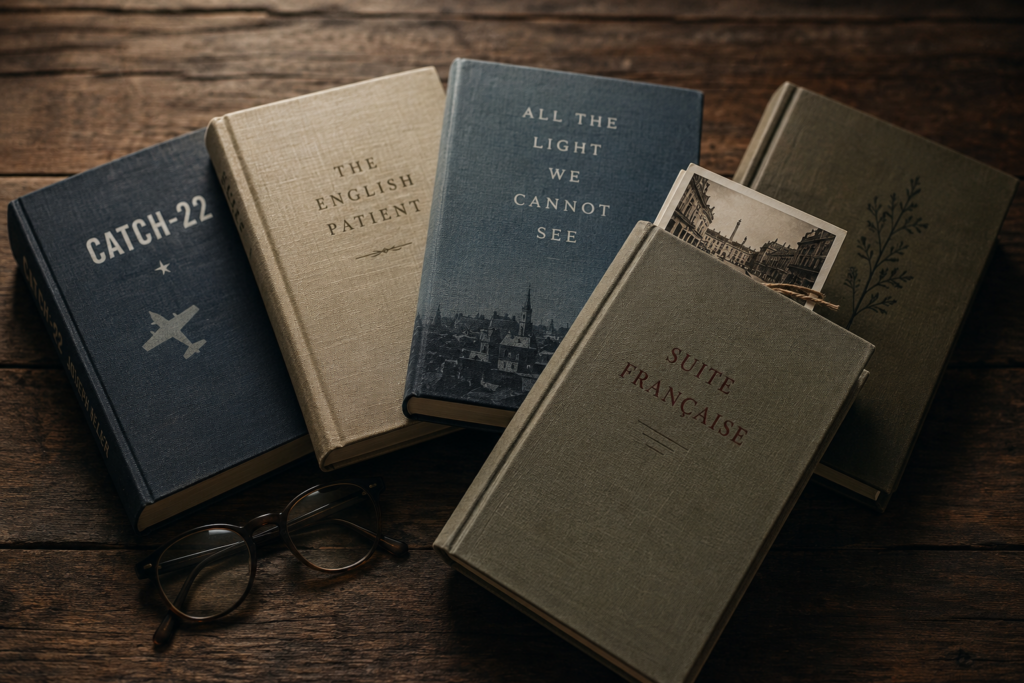
Catch-22 (1961) by Joseph Heller

Here’s the catch. A pilot is insane if he keeps flying dangerous missions without complaint. But if he complains, he’s showing the rational self-interest that proves he’s sane, which makes him fit to keep flying. What gets me every time is how funny Heller makes this while you’re inside it, so the horror sneaks up on me instead of announcing itself. The novel is technically about World War II, but really it’s about any bureaucracy that uses the logic of necessity to send people into harm’s way and then punishes them for noticing. I still can’t think of another novel that captures institutional absurdity this well.
Find a copy: Bookshop.org | Amazon
Slaughterhouse-Five (1969) by Kurt Vonnegut

Vonnegut survived the firebombing of Dresden as a prisoner of war and spent twenty years trying to figure out how to write about it before this book finally came out. Billy Pilgrim comes unstuck in time, which feels like both PTSD and the only narrative shape capable of holding what happened. The novel is about Dresden and about Vietnam, since Vonnegut was writing this in 1969, with that war at its height, and underneath both, it’s about how we organize mass death and then just keep living as if that capacity isn’t part of us. “So it goes” carries the whole book. I can’t think of another sentence in American anti-war fiction that carries so much weight with so little language.
Find a copy: Bookshop.org | Amazon
The Things They Carried (1990) by Tim O’Brien

O’Brien makes his anti-war argument through form, not just content. A true war story embarrasses everyone involved in it, he says. It doesn’t build to a point or hand you a moral, and if it seems to be heading toward meaning, that’s usually a sign it’s lying to you. I think that’s the real argument buried in the book: the war was too much for any clean narrative to hold, so O’Brien just refuses to build one. He skips the redemption arc and the lesson entirely, and by the last page I’m still carrying what he handed me.
Find a copy: Bookshop.org | Amazon
The Sorrow of War (1990) by Bảo Ninh

Bảo Ninh fought for six years with the North Vietnamese Army, and this novel came out of what he carried home from it. Kien survives the war and spends the rest of his life failing to leave it behind, sorting through memories that refuse to organize themselves into a story he can tell straight. The structure is deliberately disorienting, moving between past and present the way memory does, rather than the way novels usually organize it into something easier to follow. Every other novel on this list approaches war from an American or European perspective. This one doesn’t, and reading it changed how I read the rest. Kien’s grief has nothing to do with victory or defeat. It’s simply the accumulation of everyone the war demanded. By the end, I’d stopped caring who won.
Find a copy: Bookshop.org | Amazon
Birdsong (1993) by Sebastian Faulks

This one follows a British officer through the trenches of World War I, then jumps sixty years to his granddaughter, who is trying to piece together what happened to him. Faulks is just as interested in how that experience echoes across generations, shaping people who never saw the war themselves, as he is in the war itself. The trench scenes are some of the most visceral I’ve read. The quieter, later sections about the granddaughter hit just as hard, in a different register.
Find a copy: Bookshop.org | Amazon
The Reluctant Fundamentalist (2007) by Mohsin Hamid

A Pakistani man tells an American stranger the story of his years in New York before and after September 11: his career, his relationship, and the slow realization that the America he’d believed in wasn’t the one that actually existed. Hamid keeps the actual fighting off the page. What he’s interested in is the assumptions and divisions that make war easier to imagine in the first place. The whole book is a monologue, and since the American never gets to respond, I found myself reading from inside that silence the entire time.
Find a copy: Bookshop.org | Amazon
A note on this list
People sometimes dismiss the anti-war novel as politically motivated, as if the novels that don’t take an explicit stance are somehow neutral. No novel actually clears that bar. Every war novel takes a position, whether or not it says so. I’d rather read novels that acknowledge their position than pretend they don’t have one.
Frequently asked questions
What makes a novel anti-war rather than just a war novel?
The position it takes on the war’s justification. A war novel can be honest about cost without arguing against war itself. An anti-war novel argues that the cost exceeds, or is simply incommensurate with, what was claimed for it. Remarque, Heller, and Vonnegut all challenge the official stories societies tell about war, exposing the distance between patriotic ideals and lived experience. O’Brien argues that war resists any story that would make it mean something. Those are anti-war positions.
Is anti-war fiction always pacifist?
Not necessarily. O’Brien went to Vietnam. Heller served in World War II. Remarque served in World War I. None of them is arguing that it’s always wrong to fight. They’re arguing about the specific stories societies tell themselves about why wars are fought and what they cost. That’s a different position from pacifism, which holds that war is never justified.
Are anti-war novels always based on real experience?
Many of the most influential ones are. Remarque fought in World War I. Heller flew combat missions in World War II. Vonnegut survived Dresden as a prisoner of war. O’Brien served in Vietnam. Others, like Faulks and Hamid, write from historical research or inherited memory rather than direct experience. What matters is whether the novel confronts war honestly, not whether the writer lived it.
→ What makes a great war novel?
→ Best war books of all time
→ War Literature hub















 English (US) ·