
If you've heard the phrase “AI agents” and pictured a robot doing your job while you sip coffee, you're not entirely wrong — but the reality is both more nuanced and more exciting. At their core, AI agents are systems where an AI model doesn't just answer a single question but takes a sequence of actions to accomplish a goal: browsing the web, writing and running code, calling APIs, reading and updating files, and handing off tasks to other agents. What's fascinating is how broad this definition has become. Today, AI agents include tools like Claude Code — Anthropic's desktop and terminal app that reads your entire codebase and autonomously edits, tests, and ships code on your behalf. They include OpenAI's Codex, a cloud-based coding agent that can tackle GitHub issues and deliver finished pull requests independently. And they extend to agents controlled by Python workflow scripts, or even plain markdown files — think skill definitions, knowledge pipelines, and persistent memory documents that guide an AI's behavior across sessions without writing a single line of traditional code.
Whether you want to build your own agent from scratch, integrate one into your existing Python projects, or simply understand how to work smarter with the AI tools already at your fingertips, there's a growing shelf of books that can get you there. Here are six of the best books on AI agents available right now — covering everything from multiagent architectures and hands-on Python implementations to working with Claude Code and OpenAI Codex.
What Are The Best Books on AI Agents?
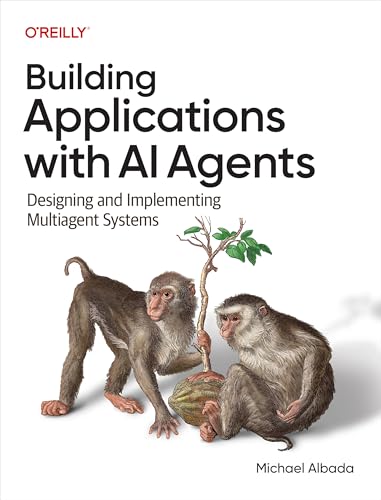
Building Applications with AI Agents: Designing and Implementing Multiagent Systems, by Michael Albada (2025)
This is a comprehensive guide to designing and deploying multiagent systems that go well beyond simple chatbots. Albada walks through how to combine tools, knowledge, memory, and learning into coordinated pipelines that let foundation models tackle genuinely ambiguous, multi-step problems — from coding agents to research agents to analyst agents and more.
What sets this book apart is its focus on the full architecture of production-ready agents: how they pass information between themselves, how they maintain state across steps, and how teams can use these systems to multiply their output. If you want to understand the building blocks of modern AI agent design before diving into any specific framework or tool, this is the best starting point on the list.

Agentic Coding with Claude Code: The Everyday Developer's Guide to Agentic Coding with Claude Code, by Eden Marco (2026)
Most developers first meet Claude Code through chat-style prompting — which quickly breaks down once projects grow complex. Eden Marco's book shows how to use Claude Code as a full agent-driven development platform, covering slash commands, persistent memory files written in markdown, skill definitions, and automated workflows that run directly in your terminal or IDE.
This book is uniquely practical because it addresses precisely the kind of agent that isn't controlled by Python code — one guided by markdown files, context documents, and structured skill prompts. If you're already using Claude Code or are curious about how agents can be configured through plain text rather than traditional programming, this is an essential read for getting real leverage out of the tool.

Codex: Your AI Coding Partner — Workflows, Prompts & Projects Using OpenAI's Codex (2025 Edition), by Julian Knox (2025)
OpenAI's Codex evolved from a code-completion model into a fully autonomous software engineering agent that can take a GitHub issue and deliver a finished pull request with minimal human steering. Knox's guide focuses on mastering the prompts, workflows, and project structures that unlock Codex's real potential — helping developers move from simple code generation into genuine delegation of complex software tasks.
The mindset shift Knox promotes is especially valuable: rather than thinking of yourself as someone who writes code, you become a system architect who reviews and directs AI output. This book is ideal for developers who want to integrate an AI coding agent into their daily workflow and get serious leverage out of tools like the Codex CLI and the Codex desktop app.

AI Engineering: Building Applications with Foundation Models, by Chip Huyen (2025)
Chip Huyen's AI Engineering became the most-read book on the O'Reilly platform since its release — and for good reason. It covers the full stack of building production AI applications with foundation models, including evaluation frameworks, RAG pipelines, prompt design, and agent architectures, all from the perspective of someone who has shipped real AI products at scale.
The agent chapters are particularly thorough, walking through how to design reliable tool-use, memory, and multi-step planning systems that hold up in production rather than just in demos. If you're a developer or technical lead who wants a rigorous, no-hype guide to what AI engineering actually looks like in practice — including where agents fit and where they don't — this is the book to have on your desk.

Building Agentic AI Systems: Create Intelligent, Autonomous AI Agents That Can Reason, Plan, and Adapt, by Anjanava Biswas and Wrick Talukdar (2025)
Written by enterprise AI architects who have built real-world agentic systems at Amazon and beyond, this Packt book takes a deeply practical approach to the coordinator-worker-delegator model of multi-agent orchestration. It covers multi-step planning, tool integration, control loops, and the decision architecture that separates reliable production agents from one-off demos.
One thing that makes this book stand out is its grounding in real enterprise use cases — the kind of Python-driven agentic workflows that run inside organizations, handling research pipelines, analyst tasks, and automation chains at scale. If your goal is to build agents that actually hold up in production and grow with your team, this is one of the most hands-on resources available.

Designing Multi-Agent Systems: Principles, Patterns, and Implementation for AI Agents, by Victor Dibia (2025)
Victor Dibia is the creator of AutoGen Studio and a core contributor to AutoGen — the open-source multi-agent framework with over 50,000 GitHub stars. This book takes a first-principles approach to multi-agent design rather than teaching any specific framework, walking you through how to build agent collaboration, observability, interruptibility, and trust from scratch using a purpose-built picoagents library.
The framework-agnostic philosophy is what makes this book especially durable: the patterns Dibia teaches transfer directly to LangGraph, CrewAI, AutoGen, or whatever platform comes next. It also covers distributed agent architectures, MCP and A2A protocols, and how agentic ethics differs from traditional AI ethics — making it one of the most forward-thinking books on multi-agent systems available today.
Final thoughts on books on AI agents
AI agents are no longer a research concept — they're already running in terminals, IDEs, enterprise pipelines, and everyday workflows. Whether your entry point is a markdown-driven tool like Claude Code, a Python orchestration framework, or a cloud-based coding agent like Codex, understanding the principles behind these systems will put you well ahead of the curve. The six books above give you a complete picture: from the first-principles theory of multi-agent design to hands-on guides for the specific tools that are reshaping how software gets built. Pick up whichever resonates most with where you are today, and you'll be working alongside AI agents — not just reading about them.


My profession is online marketing and development (10+ years experience), check my latest mobile app called Upcoming or my Chrome extensions for ChatGPT. But my real passion is reading books both fiction and non-fiction. I have several favorite authors like James Redfield or Daniel Keyes. If I read a book I always want to find the best part of it, every book has its unique value.











 English (US) ·