
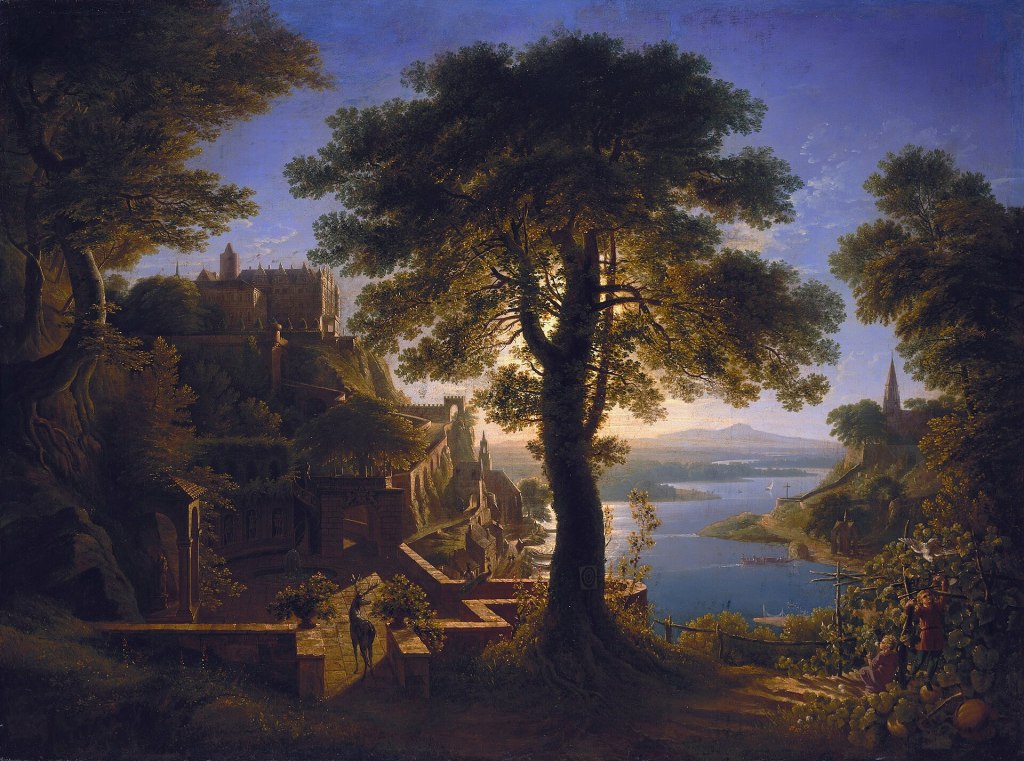
 Castle by the River (Schloß am Strom) [1820] by Karl Friedrich Schinkel
Karl Friedrich Schinkel (1781-1841) was primarily a successful Prussian architect working in the style of Neoclassicism and Gothic Revival, but he was also a talented artist, and the painting above is one of his dreamy, fantastical works where Schinkel’s eye for astonishing architectural design meets mystical, symbolic ideas about the man and nature. Castle by the River was allegedly first a mere draft conceived on a bet between Schinkel and his friend Romantic poet Clemens Brentano. The two argued over whether or not art can possibly match the swiftness with which a poet or writer can come up with narrative ideas, and whether art or poetry can better articulate complex narratives. Brentano came up with one story of an elaborate, castle-like hunting lodge near a river, which was left abandoned and overgrown, with its owner being long dead and buried across the river because the castle grounds were too rocky. Schinkel drafted these ideas on the spot and with ease, proving his point that the artist can match any poet’s imagination. His sketch was later seen and commissioned as a painting.
Castle by the River is a breath-taking work emphasising the enduring power and dominance of nature over humans and their activities, which are merely transient. The grandiose caste structure seen in the background, as well as the labyrinthine grounds, echo the nature’s own construction: a massive, ancient tree seen in the centre. The castle grounds are already being reclaimed by nature, with a deer, symbolising regeneration and rebirth, calmly walking around the property. Visually and symbolically, the tree can be said to separate the two distinct words, that of human architectural ambition (seen in decline) and the all-powerful realm of nature with its symbols and signs, represented by the vegetation and the river. There is no friction between the two in the painting – one is seen gently gaining the ownership of another. The architectural beauty has not lessened as such – it has simply changed, morphing into something else. Perhaps the artist wanted to reconcile the classical ideas of men based on order and precision with more romantic ideals with its symbols (children, a dove, crucifix), and the idea of nature being the abode of spirituality and innate emotion (intuition – also symbolised by the deer). This is a kind of painting to get lost in, thinking about its numerous details, sense of calm and mystery.










 English (US) ·