

April is National Poetry Month, AKA the time of year when I remember the promise I make every year to read more poetry. The good news is it works; while I still want to read more poetry than I currently do, this celebratory month always inspires me to do a little better than I did the year before.
Poetry can be so many things: a balm for an anxious soul, a rallying cry inspiring us to action; a sensual declaration of love or lust; a warm recollection of tender moments; an impassioned expression of pain and hurt, or of peace and joy. I’ve especially enjoyed discovering Latine poets, talented wordsmiths whose work does all of those things from a shared cultural lens. Today I’m sharing eight Latine poets whose work I deeply enjoy, from poems to novels in verse to prose. Their art reminds me why I love words, as I hope it will do for you, too.
Ada Limón

Against Breaking: On the Power of Poetry
Ada Limón is my queen, one of two poets I credit (the other is Mary Oliver) with finally convincing me that poetry is for me, and for everyone. Limón was the 24th Poet Laureate of the United States and has authored such brilliant collections as The Carrying, Bright Dead Things, Startlement, and You Are Here. She has a new book out this month, Against Breaking: On the Power of Poetry, a slim volume for anyone who maybe needs a reminder of what poetry can be and do.
I have a pinned item in my Notes app where I occasionally drop quotes and poems that have stayed with me, and one of the lines at the very top is from an Ada Limón poem called “Notes on the Below,” which she says she wrote from an almost urgent need to point back to the earth. I can’t explain why I love these lines so much, they just make me feel?! I can’t even really say what they make me feel, but I think that’s part of their wonder.
Desire is a tricky thing, the boiling of the body’s wants,
more praise, more hands holding the knives away.
I’ve been the one who has craved and craved until I could not see
beyond my own greed. There’s a whole nation of us.
Latine Lit
A bi-weekly newsletter about all things Latine literature, from news and new releases to recommendations and more!
Julia Alvarez

Visitations
I know Julia Alvarez for classics in Latine literature like How the Garcia Girls Lost Their Accents and In the Time of Butterflies, and one of my favorite reads of 2024, The Cemetery of Untold Stories. I am not as familar with her poetry, which Alvarez describes as her first love. Alvarez went ahead and gave me an easy way to remedy that gap withVisitations, a collection that came out earlier this month. These poems trace Alvarez’s “life gently, a fingertip following lines on a page, through memories of her childhood in the Dominican Republic, a dictatorship dramatically survived, the smells of sancocho and sofrito, the formative influence of her tías and her sisters, her move to America and the challenges of learning English, the search for mental health and beauty, redemption and success.” These poems are so good, as I knew they would be.
Analicia Sotelo

Virgin
I could not shut up about this collection for most of 2018; my pitch was something like, “Theseus is a fuck boy, pass it on!” Sotelo’s debut is exactly what the publisher copy says it is: an examination of feminine tropes that weaves in autobiographical elements with mythology and folklore. The poems explore questions about femininity, agency, and the lingering effects of familial trauma, using Catholic and Mexican American imagery in parts but leaning heavy into reworkings of Greek myth (I like to joke that she wrote this thing for me). One minute we’re at a South Texas barbecue where the narrator imagines herself as Persephone, the next Ariadne is sitting at “the Naxos apartment complex” realizing that Theseus, in fact, ain’t shit. These are exactly the kinds of multitudes I look for in my media. Please read this collection and revel in it’s glory.
Side note: Sotelo’s poetry also appears in You Are Here, edited by Ada Limón for the Library of Congress.
Willie Perdomo

The Crazy Bunch
Willie Perdomo is an award-winning Puerto Rican poet who was appointed New York State Poet in 2021, a role he filled for two years. His notable works include Where a Nickel Costs a Dime, Smoking Lovely, Smoking Lovely: The Remix, and my personal favorite, The Crazy Bunch, which documents a summer in 1990s Harlem.
I was introduced to this collection via a lovely review by Hanif Abdurraqib, a phenomenal poet in his own right whose stamp of approval has never steered me wrong. Here’s the line that got me to pick up this collection: “To consider the book as a golden-era rap album, these pieces read like the old clips from movies that would pop up right before songs on Wu-Tang albums.” He was not wrong, and I think I might need to read these poems again.
Elisabet Velasquez

When We Make It
Reading poetry on the page is great, but it shines most when it’s read out loud. The audiobook of this YA novel in verse is a perfect example, and made an immediate fan out of me.
It’s told from the point of view of Sarai, a first-gen Puerto Rican teen in New York City. She and her sister are being raised by their mother in Brooklyn’s rapidly gentrifying Bushwick neighborhood. Sarai walks us through her life as she processes and questions the world around her, from housing insecurity to toxic masculinity, her Boricua identity, trauma (both new and generational) and what it means to “make it.”
The author gives this powerful, dynamic performance in her beautiful Nuyorican accent, which reminds me of her poem, “Professional Spanish Knocks on the Door.” Speaking about this poem, Velasquez recalls being told she was speaking both Spanish and English wrong while growing up: “I believe part of why I became a poet was because it was impossible to speak wrong in a poem. A poem wasn’t going to grade my grammar or deny me a job because of my accent. This poem reminds me that I am enough in any language.” She is enough, alright; she is everything.
Jennifer Givhan

Belly to the Brutal
I’ve been on the unofficial Jennifer Givhan street team for years now, trying to get more people to read River Woman, River Demon and Salt Bones. While I eagerly await the release of The Sleeping Sisters this summer, I decided to go back and dive into her poetry.
I began with Belly to the Brutal, which first lured me in with its beautfully macabre cover. Motherhood is a theme Givhan explores a ton in her work, and this collection places that theme front and center. It’s described as “a corrido of the love between mothers and daughters, confronting the learned complicity with patriarchal violence passed down from generation to generation.” Givhan’s writing here is lyrically and brutally beautiful, something I’ve come to expect and deeply appreciate from this talented writer and poet.
Elizabeth Acevedo

The Poet X
I always feel like I’m cheating when I talk about National Book Award-winning Elizabeth Acevedo, like surely no one needs me to tell them about her at this point. Then again, I feel that way about a lot of authors and poets, and if this list leads even a handful of people into discovering her work for their first time, I will be thrilled.
You could start with her YA novels in verse The Poet X and Clap When You Land or her her YA novel in prose, With the Fire On High. There’s her fantastic 2023 adult debut novel, Family Lore, or her most famous spoken-word poem, Inheritance. It feels a little too obvious to say a poet has a way with words, but Acevedo just does: her language is both rythmic and raw, her characters fully drawn, flawed, and relatable, and she explores themes like religion, sexuality, identity, and cultural expectations. If you’re playing the How Many Times Will Vanessa Say She Wishes a Book Was Around When She Was Young drinking game, bottoms up! Since I can’t put her books into the hands of young me, old me will have to suffice.
Mark your calendars: Acevedo is back with a YA novel in verse this year. Anger is Only a Shadow comes out in September, a story of a rebellious and loyal teen who can’t shake the feeling that something is amiss with her older brother.
Marcelo Hernandez Castillo
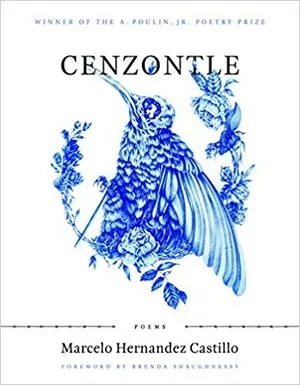
Cenzontle
You may know Marcelo Hernandez Castillo from Children of the Land, the poet and author’s award-winning 2020 memoir about growing up undocumented. But that book wasn’t the first of his to be named an NPR Best Book of the Year; Hernandez Castillo is also a poet whose past collections include Here to Stay and Cenzontle, the latter of which was also named an NPR Best Book of the Year in 2018.
I was snapping my fingers every few pages in this collection, an exploration of life before, during, and after crossing the US/Mexico border and of queerness within the confines of a heteronormative marriage. The first lines of the titular poem (Mexican Spanish for mockingbird, borrowed from the Nahuatl word “centzontleh”) can also be found on my aforementioned “quotes and poems” list.
because the bird flew
before there was a word
for flight
years from now
there will be a name
for what you and I are doing
Okay now, Marcelo! This collection is achingly beautiful.
I hope you discover a new poet, or poem, or collection from this list. For more Latine poetry, check out these 15 Latine poets who are breaking down borders.


 English (US) ·