

The Medieval era is inherently frightening. Also known as the Middle Ages, the Medieval period is generally dated from the fall of the Roman Empire in the fifth century to the onset of the Renaissance in the 13th and 15th centuries. That’s about 1,000 years. That’s a big time period, y’all.
It was an age defined by the power of the Christian church, and it was a time when, after the Roman Empire fell, the world and many of its people were struggling to define themselves—a foggy time between the cultural, philosophical, and scientific peaks of the Roman Empire and the Renaissance. To live during this period was no walk in the park.
As such, it is a ripe time period to write in, particularly for horror. What better time to play with beliefs and possibilities than during an era when these things are so malleable? When does the unknown far surpass the known?
I’ve compiled a list of horror books that are either set in the Medieval period or what I would define as Medieval-adjacent, meaning they’re set in a world that is not exactly the Medieval period but is very similar and/or tackles similar subjects. Medieval-adjacent books generally feature horror set in a secondary world (i.e., not our world), but there are always exceptions.
From religious horror to monster horror, Medieval horror books play on our expectations and imaginings of what it might be like to live during a time without the knowledge and protection of what we surely take for granted in the modern age, such as modern medicine, easily-accessible forms of research and knowledge, democracy, bodily autonomy (though some of the aforementioned seems to be deteriorating), and so forth. Here, reality and religious beliefs are intertwined, utilized to prey upon and oppress the lower classes. In these stories, people are willing to do terrible things to survive.
The Fright Stuff
Ready for some thrills and chills? Sign up to receive the latest and greatest from the world of horror.
Much of what we see in Medieval horror literature, at least when it comes to our very Westernized publishing world, takes place primarily in Europe and is written by white authors. Of course, this does not reflect the whole of the world. All the continents, from Africa to Asia, were a part of this time period. The experiences of those who lived outside Europe during the Middle Ages should not be discounted.
Unfortunately, there is a dearth of specifically Medieval horror literature set in these locations during the Medieval period, and a scarcity of authors of color writing Medieval horror. There may be more Medieval horror set outside Europe or by authors of color, but publishing doesn’t do a great job of making these titles accessible to a wider public.
Now, step back in time, dear readers. You may want to keep the lights on.
6 Medieval Horror Books

Between Two Fires by Christopher Buelhman
You can’t talk about Medieval horror without mentioning Between Two Fires, which seems to be everywhere I look lately. What began as a BookTok sensation was recently rereleased with the renowned horror publisher Tor NightFire.
Between Two Fires begins in the year 1348, and the knight, Thomas, finds an orphaned girl of the plague in a dead Norman village. The girl believes the Black Plague is part of a larger religious cataclysm, and her visions convince Thomas to escort her to Avignon. But Thomas soon realizes that the girl is more than just promises of salvation for himself and the world. This is a medieval horror-adventure that plays on the religious intensity and upheaval of the Middle Ages.

The Starving Saints by Caitlin Starling
Oh, I love me some Caitlin Starling horror. Her books, Yellow Jessamine and The Death of Jane Lawrence, are among my personal favorites. The Starving Saints is another addition to that list. This is another Medieval horror story that shows how religion and power can control the vulnerable. The story follows the siege of Aymar Castle. The castle’s inhabitants are starving and losing hope. As they plan for the horrific, suddenly the Constant Lady and her saint arrive, somehow getting past the barricade. Food is replenished. The sick are healed. Soon, the castle is under their sway, and cult-like horrors ensue.

The Works of Vermin by Hiron Ennes
This book is what I would call Medieval-adjacent. It takes place in a secondary world, so it’s not technically during the Middle Ages, but whew, the Medieval horror vibes are there, particularly in the world’s hierarchy. Also, the book is gloriously queer.
In the city of Tiliard, Guy Moulène works as an exterminator to keep his sister out of debt. The work is dangerous and the “vermin” monstrous. Guy’s latest mission is a dragon-sized centipede with venom and a hunger for artwork. Its toxin could shake the very foundations of this city, which is built into the stump of a giant tree. The atmosphere in this book is decadently disgusting with its bugs, sewers, and death. Like the Black Plague itself, the monsters in this story spread far and wide.
Ennes, who wrote the acclaimed horror Leech, is a master in worldbuilding and dread.
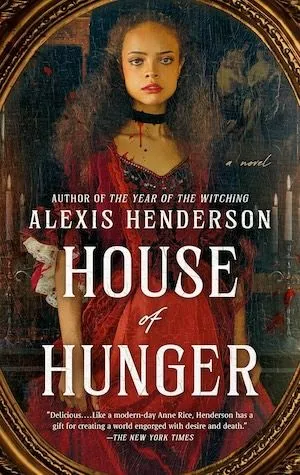
House of Hunger by Alexis Henderson
Again, this is another Medieval-adjacent book. While I believe this book might be more accurately mirroring the Renaissance or later, the story’s noblewomen strike me as noblewomen of note from Medieval times.
House of Hunger follows Marion Shaw, who lives in the slums and is desperate to escape her life of poverty. Then she sees an advertisement in the newspaper for a bloodmaid, and her world changes forever. Marion becomes a bloodmade to the alluring Countess Lisavet. In a world where the powerful and wealthy drink the blood of those who serve them, Countess Lisavet takes a special interest in Marion, and Marion finds herself eager to please her mistress. Then Marion discovers secrets and horrors that are far older than she could ever imagine.
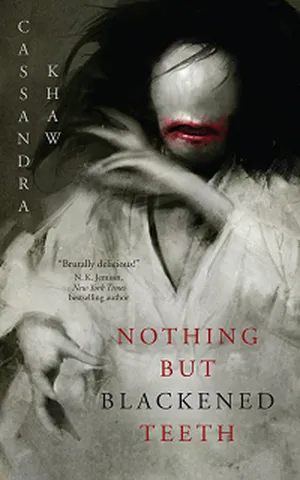
Nothing But Blackened Teeth by Cassandra Khaw
This is one of my all-time favorite horror novellas, and Khaw pulls no punches. While this book takes place in the present, the abandoned mansion and the ghost therein are from the Heian era, a classical Japanese time period that lasted from 794 to 1185.
A group of thrill-seeking friends reunites after time apart to celebrate the wedding of two of their own, and they want to hold it at an abandoned Heian-era mansion. This story goes that the mansion is built upon the bones of a bride, and the walls hold the remains of girls sacrificed to keep her company. The bride hungers still. What begins as a thrill-seeking romp morphs into a tale of endless hallways, an ancient entity seeking more sacrifice, Yōkai, and tragedy.
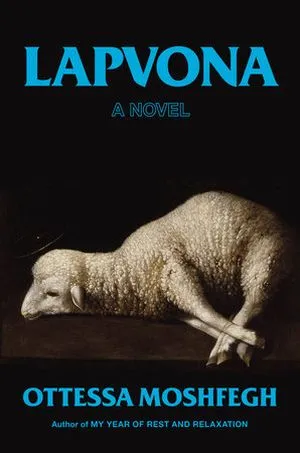
Lapvona by Otessa Moshfegh
Reading Moshfegh’s debut novel, Eileen, rocked my world. I love how Moshfegh plays with and across genre boundaries, then pushes them even further.
Lapvona terrifies me. Moshfegh creates a Medieval world that follows a motherless shepherd boy named Little Marek. Abused and delusional, Little Marek takes solace in his bond with the local midwife, Ina. While some believe Ina’s connection to the natural world is a gift and talent, others see Ina’s abode in the woods as a godless place. Ravaged by natural disasters, the village looks to its deviant lord and governor. Little Marek is suddenly cast into the governor’s circle, and his depraved family, and sinister, supernatural forces work to put the village into startling upheaval.
Medieval horror peels back the flesh of the past to process the present, mirror it, dissect it, or all of the above. It’s a way to ask ourselves whether we are much different from those of the past and/or whether we have learned from past mistakes.
It seems, especially lately, we very much haven’t.
For those seeking more recommendations for books of varying historical periods and genres, some ideas:











 English (US) ·